mind
Brainspotting
Find the spot where the eyes land — and let the system process.
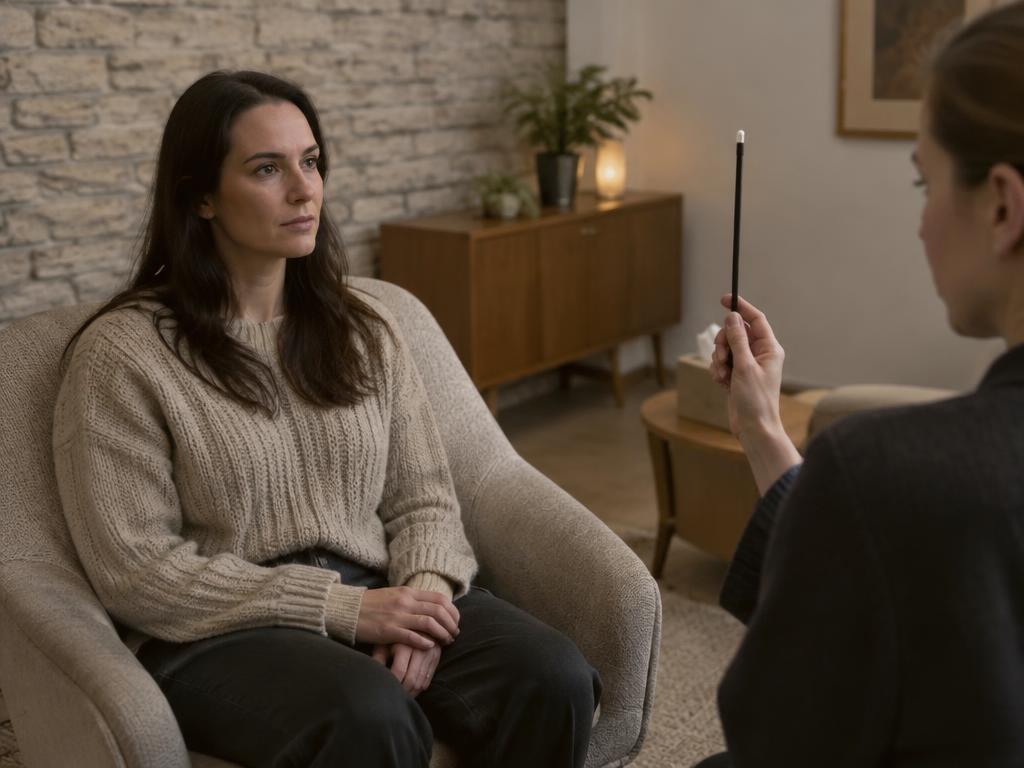
A therapist-guided approach that uses a fixed eye position — a 'brainspot' — to help the body process stuck stress and trauma.
Developed by David Grand in 2003 as an offshoot of EMDR, Brainspotting rests on a simple observation: where you look affects how you feel. While holding attention on a distressing feeling, the therapist slowly moves a pointer across your visual field until you notice a spot that feels charged, odd or activating — a little like finding the tender knot when foam rolling.
You then hold your gaze on that spot, with the therapist attuned beside you, and allow whatever arises — sensation, emotion, memory, or simply release — to move through. Many people describe it as quiet, body-led processing rather than talking.
What the evidence says
Emerging evidenceBrainspotting's research base is still small. Early controlled studies suggest effects comparable to EMDR for trauma symptoms (Hildebrand et al., 2017) and reductions in PTSD and anxiety symptoms in pilot trials. Proposed mechanisms — that eye position accesses subcortical processing — are not yet established. It should be practised with a trained therapist, and evidence is weaker than for EMDR or trauma-focused CBT.
References
- [1]Hildebrand, A., Grand, D. & Stemmler, M. (2017). Brainspotting — the efficacy of a new therapy approach for the treatment of PTSD: a randomized controlled trial. Journal for Neural and Psychological Psychotherapy (Zeitschrift für Psychotraumatologie), 1, 37–46. Link ↗
- [2]Grand, D. (2013). Brainspotting: The Revolutionary Therapy for Rapid and Effective Change. Sounds True. Link ↗
Guided care_links
Exercises
Practical, paced ways into brainspotting. Start with whichever one feels least effortful — capacity returns through small, repeated doses, not heroic ones.
- 01
One-off research
Finding a Therapist
Why it works · Brainspotting for trauma is designed to be done in a safe, attuned relationship; working with a trained practitioner is the core of the method.
Loading…
Take care
- Do not use self-guided gaze work to process serious trauma alone.
- 02
5–10 minutes
Resource Spot (Self-Guided)
Why it works · Pairing a calm body feeling with a gaze position is a gentle self-resourcing version of the method, helping the system anchor safety.
Loading…
Take care
- If you feel distress, look away, orient to the room and stop.
- 03
5 minutes
Gaze & Sensation Noticing
Why it works · Practising curiosity about how eye position changes feeling builds the focused mindfulness Brainspotting relies on.
Loading…
Take care
- Use only mild stressors when practising alone.


